How She Handles 500 Clients with 1 AI Workflow (ft. Callan Faulkner)
AI educator and consultant. She closed a real estate consulting business in 2023 to build an AI education company, and now trains small business owners and enterprise teams on using AI as a communication skill rather than a shortcut.
Key takeaways
- Most owners who say they use AI are running one line requests and shipping the first draft back out, which is the thing Callan says is not actually using it
- Her prompt has four parts, and the fourth one, asking the model what else it needs to know, is the part almost nobody does
- A project is instructions plus knowledge, and the knowledge is what turns a generic answer into one that sounds like you
- One custom GPT trained on her own coaching absorbed 500 client chats in two weeks, questions a human would otherwise have answered
- She will not put an avatar in front of clients, because the coaching itself is the one part she does not believe should be replicated
Callan Faulkner has about five hundred people in her program. In one two week stretch, the thing she built to support them handled five hundred chats.
That is five hundred questions a human on her team would otherwise have answered one at a time. She did not replace her coaching to get there, and that distinction turns out to be the whole point of the conversation.
She runs The Uncommon Business, an AI education company. Before that she ran consulting for real estate investors. The switch happened faster than most career changes do.
THE TEN MINUTE SOP THAT ENDED HER LAST BUSINESS
In July 2023 she was in the middle of a divorce and sitting down to write a standard operating procedure, which she describes as absolutely her worst thing. She is a visionary. She would rather go get a job than build documentation.
Then she watched a video of someone recording himself talking through a process, dropping the transcript into ChatGPT, and telling it to act as a world class technical documentation specialist and format the whole thing.
Two or three hours became about ten minutes.
She is careful about what actually moved her, and it was not the clock. It was the bandwidth. The effort and energy that task used to cost simply stopped being spent.
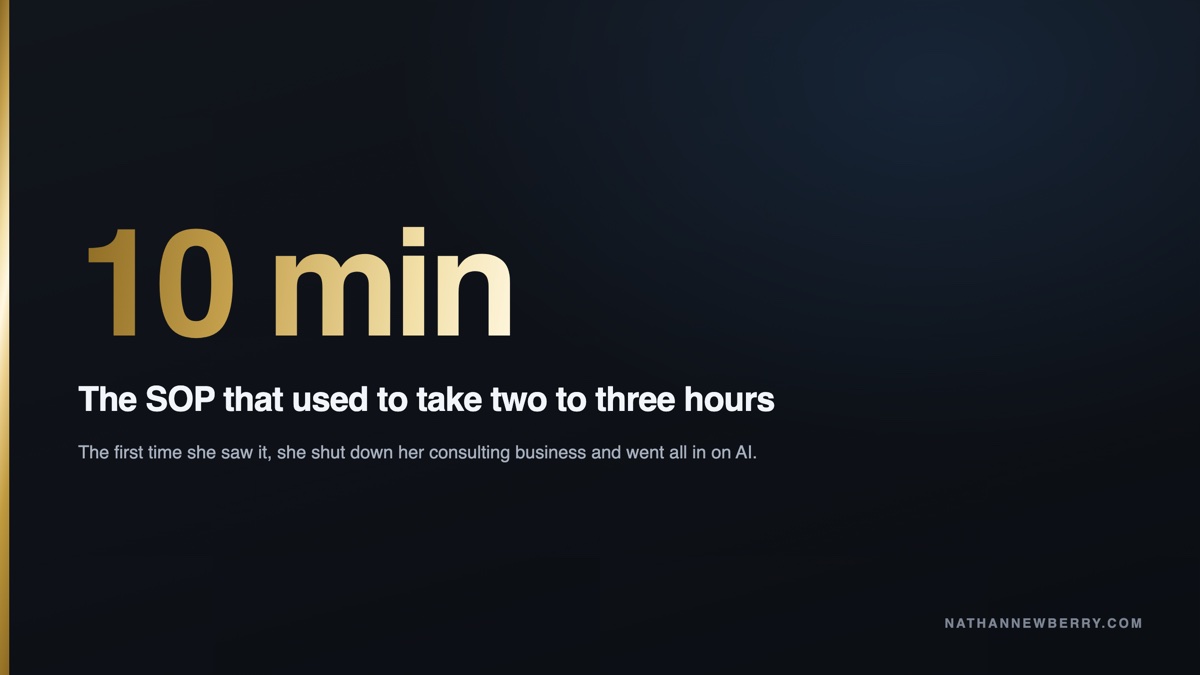
A few months later she was in the Canadian Rockies, came out of a breathwork session, and knew she had to shut the consulting business down and go all in. She could not explain it to her business partner at the time beyond calling it an intuitive hit. The Uncommon Business started from there.
NOBODY IS ACTUALLY USING IT
I asked whether she still finds industries reluctant. Her answer was faster and flatter than I expected.
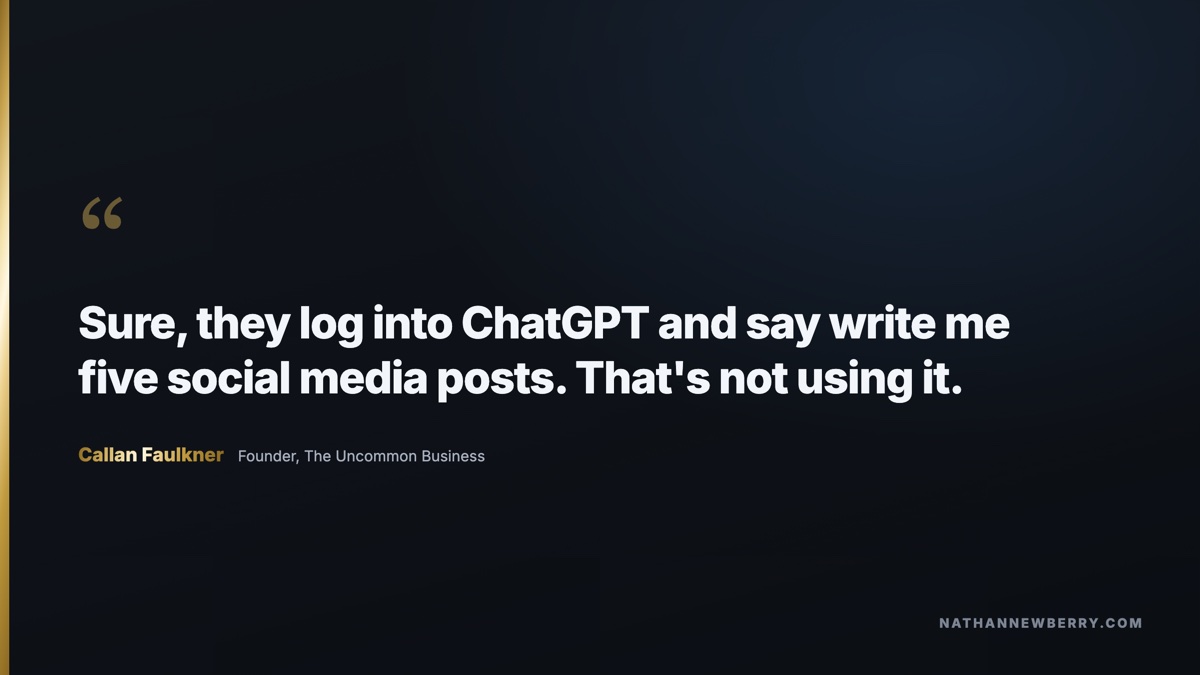
Sure, they log into ChatGPT and say write me five social media posts. That's not using it.
She describes what most people are doing as reactive. They open it when they are overwhelmed, accept the first draft that comes back, copy it, paste it, and ship unread work. Speed over quality, settling for surface level output.
Her example is a private equity owner she met hiking in Aspen who owns thirty companies. He told her he used it for his emails. She asked what was keeping him up at night, and it was raising forty million dollars in ninety days. They ran that through her prompting framework, interviewed him properly, excavated the detail, and he got back something he had not thought of.
His reaction was that if he had trained an intern to work through it that way, the intern could have presented him with solutions.
HER PROMPT HAS FOUR PARTS
This is the practical core of the episode, and it is simple enough to use this afternoon.
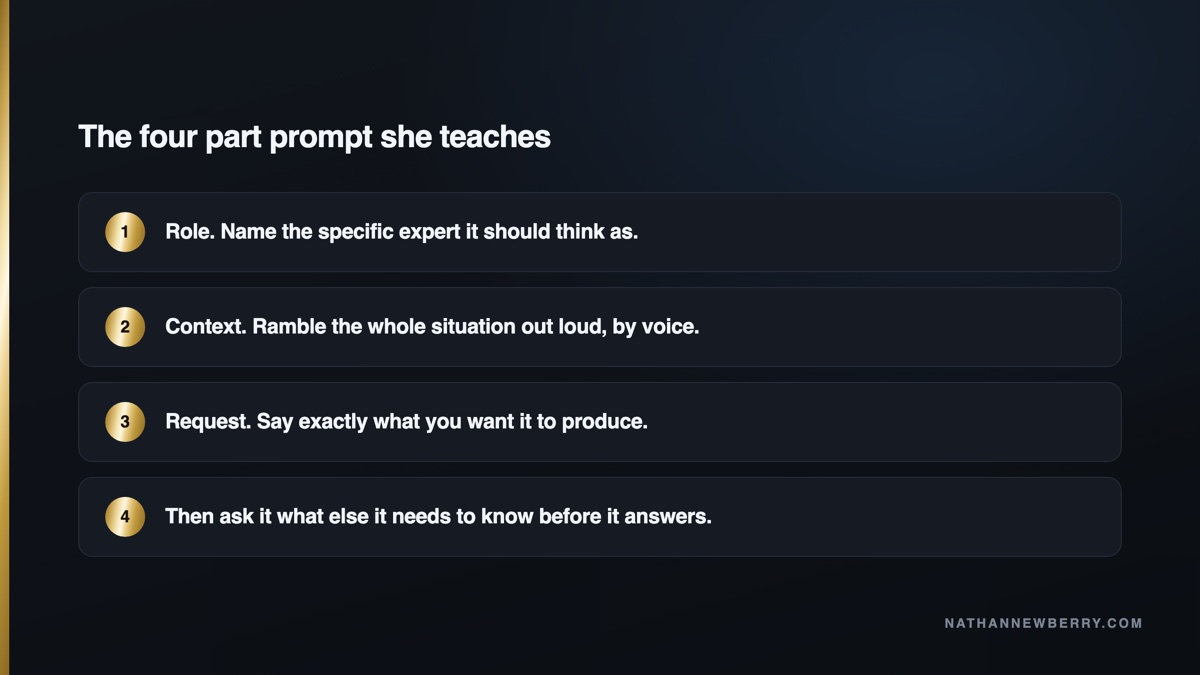
Role. Not a generic expert. A specific one. If you tell it to help you fire someone, it goes to the most generic source it can find and gives you the Wikipedia version of that conversation. She names Kim Scott, who wrote Radical Candor, and gets an entirely different conversation. For a conflict at home she names John Gottman, who studied over seventy thousand couples.
If you do not know who to name, ask it. Her actual move is to ask which thought leaders are good at turning chaos into clarity, and why each one might fit her.
Context. Ramble. She is emphatic that typing is the wrong input, because typing makes you tidy and tidy loses the detail. Use voice and stream everything, personal and professional together, the car wash and the mice in the basement alongside the business problem.
Request. Say what you actually want it to do. Listen. Build a schedule. Draft the delegation messages to each person on your team.
Then ask what it still needs. Her wording is to ask whether it really has all the information it needs, and what else it could request that would produce a better answer. Her reasoning is that the model wants to make you happy, so it will never volunteer that it has a hundred questions. You have to invite them.
AI IS A MIRROR, WHICH IS WHY REGULATION MATTERS
Her example of getting this wrong is domestic and small on purpose. A couple disagreeing about a couch.
Go in saying he is being impossible and scarce about money again, what should I say to him, and you will get exactly that energy handed back to you along with a text to send. She calls the model a mirror. It reflects the frequency you bring.
The better version names Gottman, asks for a neutral read, asks to be interviewed first, and then asks to be put in the other person's shoes to understand what they are feeling.
This connects back to the first thing she said about high performance, which was emotional regulation. Staying calm in the centre of the storm so decisions come from facts, data and intuition rather than emotion. The tool exposes which one you are operating from.
The few AI systems that genuinely take hours off an owner's week, without a tech stack.
A PROJECT IS INSTRUCTIONS PLUS KNOWLEDGE
Loose chatting she calls on the fly prompting. It works, but you pay for it every time in background.
A normal chat has no idea who your ideal client is, your voice, your tone, your mission, your pillars, which of your past content performed, or what worked for your competitors. All the things a genuinely good social post requires are missing, so you supply them again and again.
A project fixes that, and it has exactly two parts.
The instructions set who it is, what it does, what it is good at, its communication style, its core principles, its approach and its boundaries. Hers include things as specific as not giving legal advice, and what to say when someone opens with "I have a question."
The knowledge is the upload. For her that means every transcript of her coaching, from this program and past ones, plus every link a client might need.
She uses Claude for anything she is writing, and says it outranks the others for content and reads more human. Perplexity for research where sources have to hold up, which matters for the doctors and functional practitioners she works with. Grok for consumer sentiment, and she gave a good example of pulling Reddit threads on why people quit chiropractic care plans, then building a keynote around preventing exactly those reasons.
She is also disciplined about the stack. Her line is that if a new one comes in, something has to go to Goodwill.
THE BUILD THAT ABSORBED FIVE HUNDRED CHATS
The command center is a custom GPT every client in her program can open.
She built it in ChatGPT rather than Claude for one unglamorous reason. Claude projects cannot be shared outside the organisation, and hers had to reach clients.
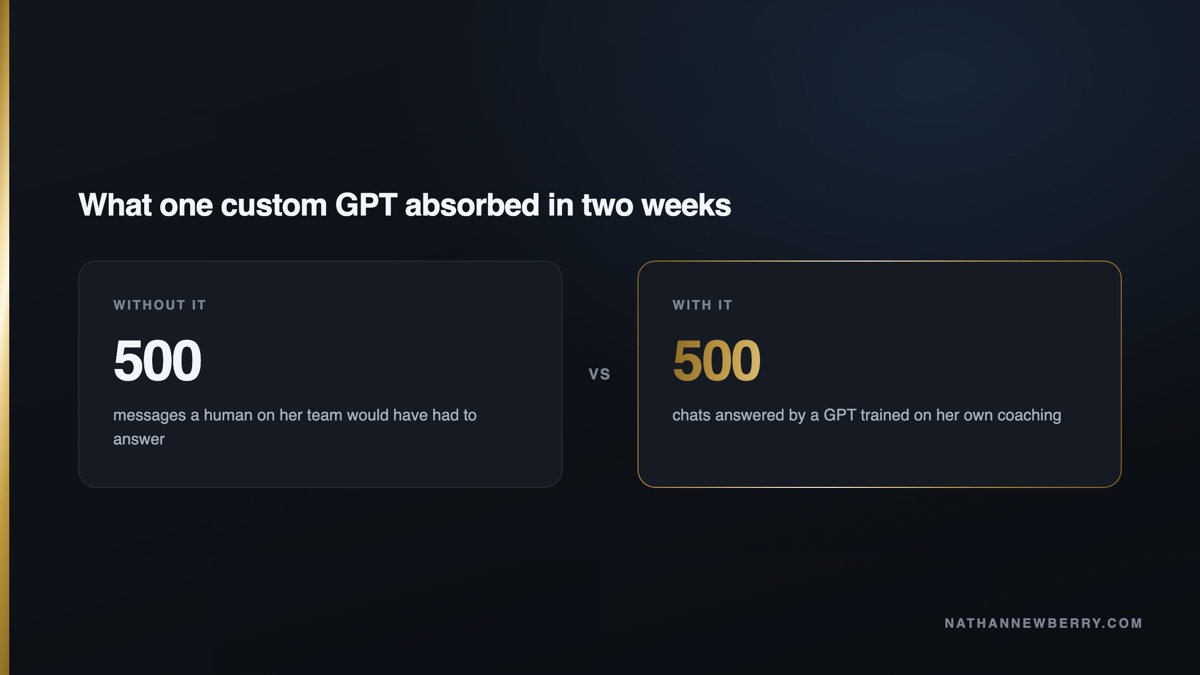
Five hundred chats in two weeks. Five hundred messages someone internally would have had to write.
The difference between that and a client typing the same question into a blank ChatGPT window is not the model. It is that hers has watched her solve problems, sat through her hot seat coaching, and knows how she thinks. As I put it to her on the episode, she built her own extension of herself. She agreed without hesitating.
This is the same principle as any other handoff. You are not removing yourself from the work, you are removing yourself from answering the same thing for the fiftieth time. That is what the systems stage is actually for, and it is the reasoning behind the free AI Systems playbook too.
THE LINE SHE WILL NOT CROSS
I asked what coaches specifically should be doing with this, and she said her answer would be unpopular.
The classic advice is to recreate your avatar and let it coach for you.
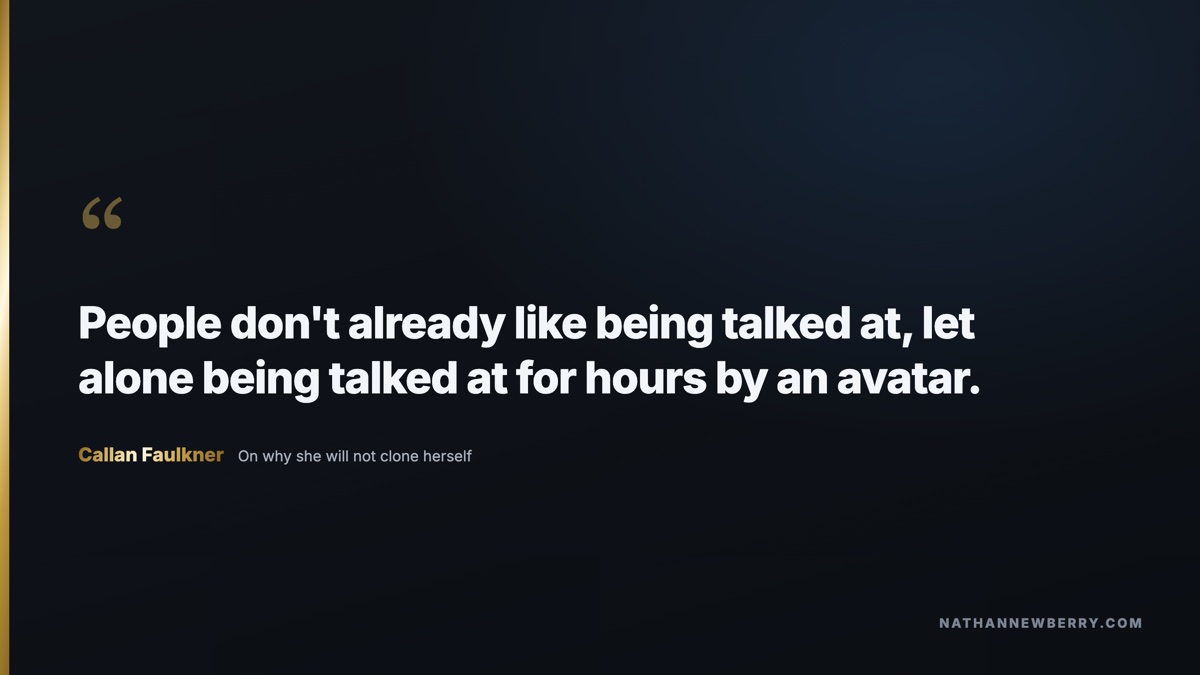
People don't already like being talked at, let alone being talked at for hours by an avatar.
She allows that it might work in a very low ticket program. Beyond that she thinks it is emotionless, it is not authentic to how she coaches, and she is not sure she will ever want to recreate it. She is goofy when she coaches. She makes jokes. She believes there is something in the human to human exchange that does not survive the copy.
So the AI sits behind her instead. She loads every framework, story and client breakthrough into a curriculum builder, talks into it for a minute about what she wants people to leave with, and gets seventy percent of the curriculum back. Her team preps week five before she logs in, based on what she has already said and how she already thinks.
WHAT CHANGED WHEN SHE STOPPED BEING THE DOER
To get to half a million she was everything. The salesperson, the marketer, the launch planner, delivery, onboarding.
At that mark she started bringing in A players, and her description of the job now is short. She shows up to train. She goes and walks in the woods and works out where the business should go. She does keynotes and builds relationships.
Her director of growth ran an entire launch recently and Callan never looked at the sales page or the marketing emails, because the project that writes in her voice already existed. Her words were that she does not even need to be shown it.
That is the actual sequence, and it does not start with the tool. Get the thinking out of your head and into something durable, whether that is a document, a project, or a person. Then the leverage has somewhere to attach.
If you want the version of this built around your week rather than hers, the free workshop walks through it.
Questions about this episode
What is the four part prompt framework?
Role, context, request, then clarifying questions. Name the specific expert you want it to think as, ramble the whole situation out loud rather than typing a tidy summary, say exactly what you want produced, then ask the model what else it needs from you before it answers. Callan's view is that the fourth part is where most of the quality comes from and it is the part almost everyone skips.
What is the difference between a chat and a project?
A normal chat starts from nothing every time, so you spend the first half of it supplying background. A project has two parts, custom instructions and knowledge. The instructions set the role, the principles and the boundaries. The knowledge is the files, transcripts and links it can draw on. That combination is what makes the output sound like you rather than like the internet.
Which AI tools does Callan actually use?
She uses Claude for anything she is writing, because in her assessment it ranks highest for content and reads more human. Perplexity for research where sources have to be citable, which matters for her clients in medical fields. Grok for consumer sentiment, because it can read what people are actually saying publicly. She is deliberate about not adding more.
Should coaches replace themselves with an AI avatar?
Callan says no, and she is blunt about it. Her position is that people already dislike being talked at, and an avatar makes that worse. She uses AI heavily behind the scenes for curriculum, prep and client support, and keeps the actual coaching human.
Build A Business That Funds Your Calling
Two free next steps. Both take one sitting.

Nathan has led sales teams doing seven figures a month and guided more than 100 owners past six and seven figures. He hosts The Nathan Newberry Show and works with Christian business owners on the offer, the pipeline and the systems that carry the work. More about Nathan