$48M In 48 Months: How Aaron Spivak Did It With No Degree
Aaron Spivak dropped out of school, cofounded Hush, the weighted blanket company, and sold it at 25. He now runs The Founders Club, a vetted community of about 400 founders doing seven, eight and nine figures a year.
Key Takeaways
- Aaron spent on ads longer than his competitors because he knew a customer paid him back within 90 days.
- He says most owners leave a season too early, and the next door only opens when you finish the one you are in.
- Pick a cofounder like you would pick a spouse, on shared values and honest talks, not just on skills.
- Before you hire an A player, be honest about whether you are ready to lead one.
Aaron Spivak never finished high school.
He still built a company that did about $28 million a year in sales, and he sold it at 25.
When I asked him what made the biggest difference, I expected him to say ads. Or a great team. Or a book.
He said none of those.
The most important thing was hands down our ability to understand our finances.
That one answer is worth the whole episode. So let me walk you through it, along with what he said about seasons, partners, hiring and AI.


From Window Cleaning To The Weighted Blanket
Aaron's parents were immigrants. His dad worked from 6 in the morning until 8 at night. His mom drove the school bus.
Nobody sat him down and told him to start a business. He watched how hard they worked, and he did the math. If he wanted the new hockey stick, he had to earn it.
So at 13 he was cleaning windows. Then shoveling driveways. Then sealing them.
Later he dropped out of school. A friend connected him with another young guy who had also dropped out. That guy became his cofounder.
One day his cofounder sent him an article. About one in four North Americans had trouble sleeping. More were dealing with stress and worry.
His cofounder remembered a camp for kids with special needs. They used weighted pads to help the kids calm down and sleep. So he asked a simple question. Why not make one for adults?
They made one sample. They built one landing page. They ran a few ads.
Three sales came in. Then five. Then ten. Then $30,000 a month, $90,000 a month, $150,000 a month. They still only had one sample.
That company became Hush.
The Hours Nobody Posts About
Here is the part people skip.
Aaron was running six juice and smoothie shops at the time. He opened at 6 in the morning and worked until 5. Then he met his cofounder and built Hush until 1 in the morning. Every day. For a year.
He told me he worked 20 to 22 hour days. He slept in short naps. He worked as a DJ on weekends to pay his rent.
Even when Hush was doing millions, he kept the money in the business so it could keep growing.
He does not tell people to copy that. He is honest that it took a toll. But he also says that season built the man he is now.
Don't Leave A Season Too Early
This was one of my favorite parts of our talk.
Aaron says the seasons of an owner are not like the seasons of the year. They do not come on a schedule. They depend on your market, your skills, your age, your family and the money you have or don't have.
Everything in our body wants us to leave a season and move to potentially an easier one.
His point is simple. The next door only opens when you are ready for it. And you get ready by finishing the season you are in.
Most owners quit too soon. They hit a little success, or they feel stuck, and they jump to something new.
Aaron says the right time to move is almost always later than you think. And one day you just know. He told me he could not work those long days again now, not for any amount of money. That part of him is done.
I have seen this in my own life. The hard seasons were the ones that grew me. I would not trade them.

The 90 Day Math That Beat His Competitors
Here is the simple version of how Aaron thinks about money. He went slow with me, so I will go slow with you.
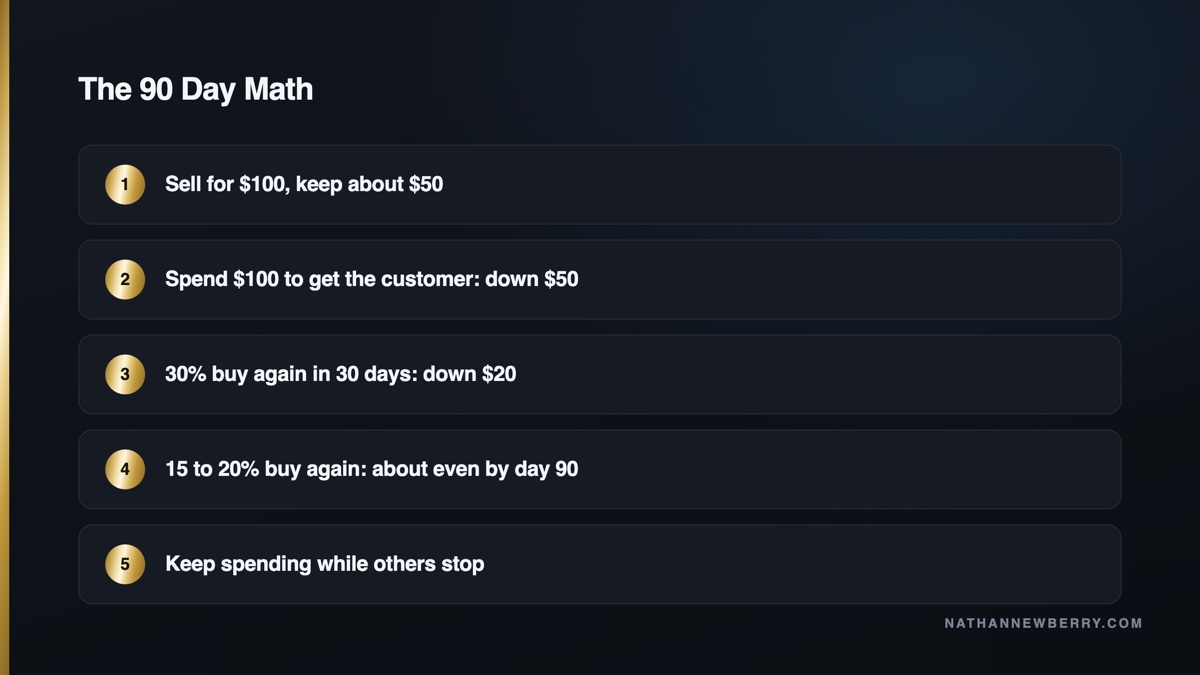
Say you sell something for $100. After product cost, shipping, returns and overhead, you keep about $50.
Now say it costs you $100 in ads to get that customer. You are down $50. Most owners see that and turn the ads off.
Aaron did not look at the first sale. He looked at the first 90 days.
- About 30 percent of new customers bought again within 30 days. That brought back about $30.
- Another 15 to 20 percent bought again in the next 30 days.
- By day 90 he was even or a little ahead.
So he knew he would get his money back. That meant he could keep spending when everyone else stopped.
If you and I both launched on the same date, you would stop spending and I kept spending. So over a long period of time, I had a million customers.
Then his team worked to raise that repeat number. New products. Better care. Bigger bundles.
And once you have a big list, every launch gets easier. When they launched a pillow, they sold 3,000 in a day. They sent one email to a list of over a million customers.
This is why I keep telling owners to know their numbers every week. Not once a year from your accountant. Every week. If that sounds like a lot, start with my free 7 Numbers Scorecard. It takes about ten minutes a week. I also wrote about the two numbers every business is chasing if you want a place to start.
You Don't Need A Finance Degree Anymore
I asked Aaron if all this needs a big spreadsheet and a team.
He said it used to. He would sit with his accountant for hours to work out what each group of customers was worth.
Now he says you can export your orders and hand them to an AI tool. Ask it what customers spent in their first 30 days and their first 90 days. It does the work in seconds.
So the excuse is gone. You do not need a degree. You need to care about the numbers enough to look.
The one page weekly scorecard I set up with every client first.
Pick A Cofounder Like You Would Pick A Spouse
A lot of owners pick a partner off a resume. You are good at sales, I am good at product, so let's go.
Aaron says that is not enough.
You will spend almost every working hour with this person. You will get tested by your team and your competitors. If you ever sell, the buyer will pick your company apart.
So you need the same core values. You need to have hard, honest talks often. And you both have to keep growing.
Resentment has destroyed more companies, more businesses and more partnerships than whatever's happening in the market at the time.
That is true in marriage too. When we stop talking, resentment grows.
Be Honest About Who You're Ready To Hire
Everybody wants to hire A players right now. Aaron says that is easy to say and hard to do.
His point surprised me. Sometimes the owner is not ready for an A player yet. Sometimes you are not ready to lead a hungry C player who wants to grow, because you are not an A player at that job either.
That is okay. Just be honest about it.
When Aaron hired his first head of HR, he told people the truth. He said he had never taken an HR course. He did not really know what HR was supposed to do. They would be starting from nothing.
The right person said yes to that. Someone who wanted structure would have said no, and that is fine too.
Then as the business grows, you raise the bar. If you are trying to figure out when to bring on help, this post on when to hire your first person will help.

AI Made Knowledge Free. Now People Win On Character
Aaron told me a story about a clogged drain at his house.
The plumber pulled something out of the pipe and wasn't sure what it was. Aaron took a video on his phone, gave it to an AI tool, and asked what was wrong. It said a tree root was growing into the pipe. The plumber agreed.
His point was not that plumbers are done. It's that knowing things is no longer the edge. A kid with no degree and a Harvard grad can now get the same answer in seconds.
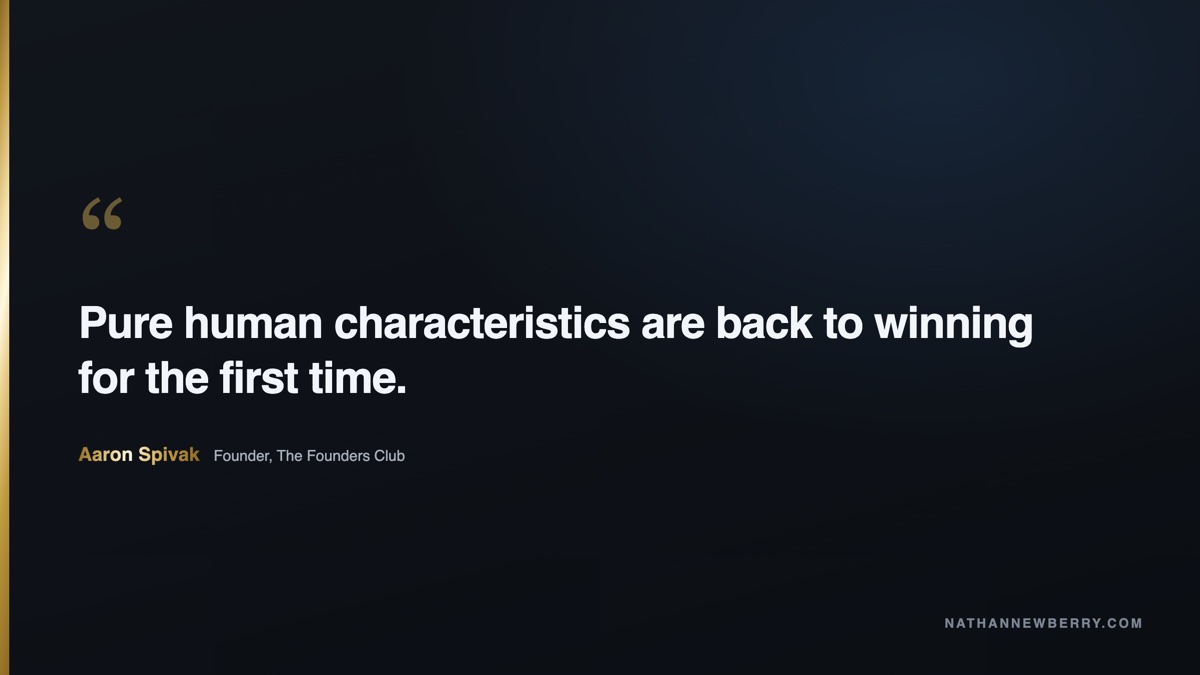
Pure human characteristics are back to winning for the first time.
So what wins now? Grit. Stamina. Being curious. Showing up every day. Being someone people like and trust.
I agree with him, and I would add one thing. AI cannot lead people. People still follow people. That is good news for owners who are willing to grow as leaders.
What This Means For Your Business
Aaron also told me how he runs his health now. It is his top priority. He stacks his sauna, cold plunge and other habits into one short session so it does not eat his day. His energy sets the tone for his team.
So here is what I would take from this talk.
1. Know what a customer is worth over 90 days, not just on the first sale. 2. Finish your season before you jump to the next one. 3. Choose partners on values, and keep the hard talks going. 4. Hire for where you really are, and raise the bar as you grow. 5. Use AI to learn fast, then win on character.
If you want help building a business that grows without running everything through you, that is what we do inside the Impact Freedom Accelerator. We work on your numbers, your team and your systems every week, with other Christian owners doing the same.
And if you are not ready for that yet, grab the free 7 Numbers Scorecard and start tracking this week.
You can follow Aaron on Instagram. Watch our full conversation in the video above.
Common Questions
What Is 90 Day Customer Value?
It is how much a new customer spends with you in their first 90 days, not just on their first order. Aaron used it to decide how much he could spend to get a customer and still come out ahead.
How Do I Work Out My Customer Value Without A Finance Team?
Export your orders from your store and ask an AI tool to group them by the month each customer first bought. Then look at what each group spent over 30, 60 and 90 days. Aaron says this used to take him hours with his accountant.
How Should I Choose A Business Partner?
Aaron says to treat it like choosing a spouse. Different strengths help, but shared core values and the habit of hard, honest talks matter more. Resentment has ended more partnerships than any market has.
When Should A Small Business Hire An A Player?
When you can lead one. Aaron says some owners are not ready for an A player yet, and that is fine. Be honest in the interview about where the business is, and raise the bar as you grow.
 Watch The Full InterviewOn YouTube
Scale Your Business So It Funds Your Calling
If everything in your business still runs through you, join the Impact Freedom Accelerator or grab the free tools I use with members.
Want 1:1 Help? Talk With Me First
Nathan Newberry is a business advisor, sales leader and former pastor. He helps Christian owners of established businesses scale so the business makes more money, needs less of them, and funds their calling. He built and sold a marketing agency, has interviewed hundreds of business advisors, and leads the Impact Freedom Accelerator. More about Nathan