Why Most Coaches Burn Out at $100K (And How to Scale Without More Clients) ft. Robin Waite
Business coach, speaker and author of Online Business Startup, Take Your Shot and Fearless Pricing. He ran a design and advertising agency for twelve years before launching Fearless Business in 2016.
Key takeaways
- You can reach 100K on effort alone, which is exactly why the wall after it catches people by surprise
- The block at that point is complexity, too many offers for too many types of people, not a lack of leads
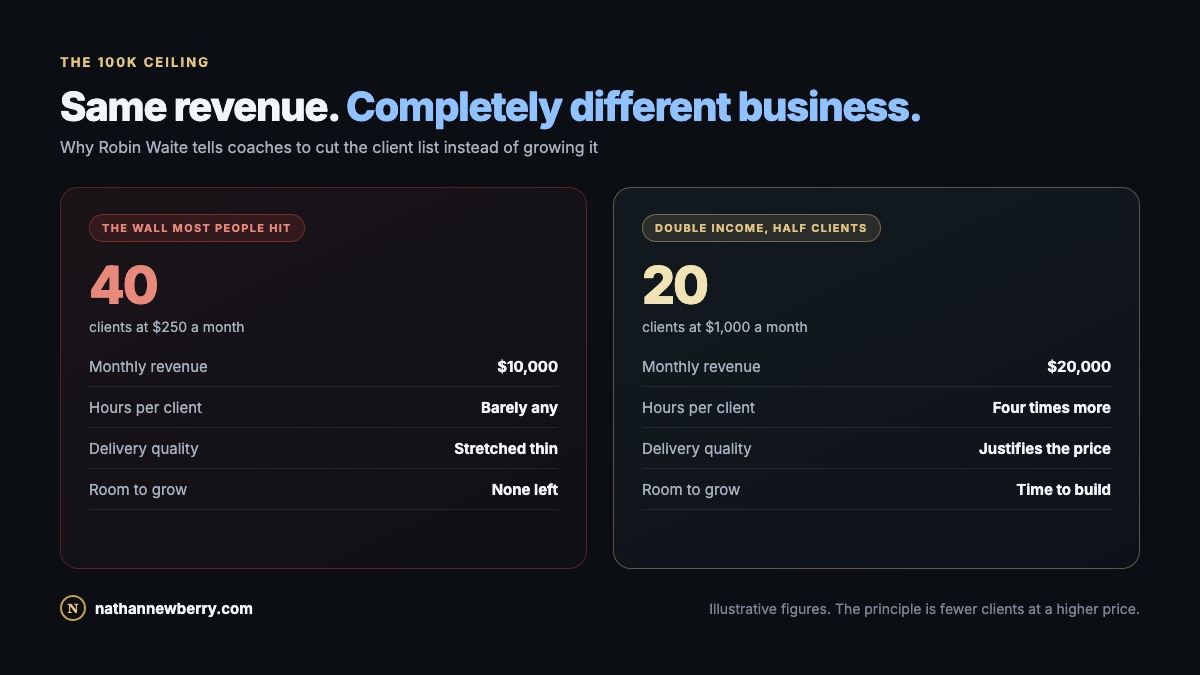
- Robin's target is double the income with half the clients, because fewer clients at a higher price is what buys time back
- One podcast appearance in 2023 produced about 3,000 leads and roughly 250,000 pounds in revenue, and still sends leads today
- The real cost of saying no to help is the second and third order consequence, measured in years of standing still
You can wing your way to a hundred thousand. That is the part nobody warns you about.
Robin Waite has written several books, speaks on stages, and runs Fearless Business, a group coaching accelerator working mostly with coaches, consultants and freelancers. Before that he ran a web design and branding agency for twelve years. He knows the wall that shows up right after the first milestone because he hit it himself, and it cost him the company.
I asked him the question I ask every guest, which is what high performance actually means. His answer set up everything else we talked about.
HIGH PERFORMANCE IS HITTING THE GOAL WITHOUT BURNING OUT
Robin's definition is short. Achieving your goal without burning out.
He thinks most people grow far too fast to manage that, and the pattern is the same in the UK where he is and in the States. Everybody wants the six or seven figure business. That is fine as an ambition. The problem is what it takes to get there.
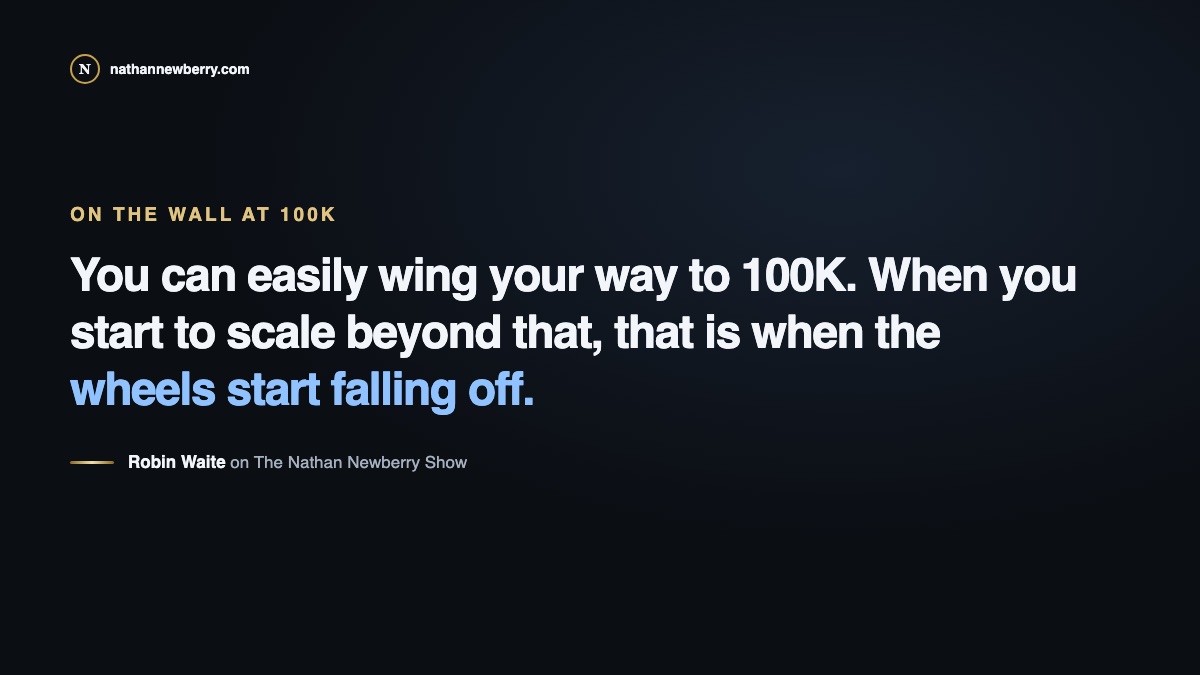
You can easily wing your way to 100K. When you start to scale beyond that, that is when you start to see the wheels falling off and the engine breaking for the business.
That sentence is worth sitting with, because it reframes what the wall actually is. The first hundred thousand does not require a system. It requires you, working hard, saying yes to most things. Which means the business that arrives at that number is a business built entirely around one person's effort, and there is no more of that person to give.
WHY THE WHEELS COME OFF AT EXACTLY THAT POINT
Robin's diagnosis is not a lack of leads. It is a lack of simplicity.
His words are that people get found out at that point, because they are probably doing too many different things for too many different types of people. There are too many moving parts in the organisation. Everything that felt like resourcefulness on the way up becomes drag on the way past.
So the work he does with clients at that stage runs in the opposite direction to instinct. Simplify. Remove variables. Streamline. It is the same reason the five stages run in order rather than all at once. Get the business narrow enough that it can survive more volume rather than wide enough to catch every opportunity.
If you can get past a hundred thousand without burning out, he says, that is what high performance looks like.
THE AGENCY THAT ALMOST BROKE HIM
The reason he can spot this so quickly is that he lived through the version where nobody caught it in time.
He ran his agency for twelve years and grew it to around two hundred and fifty thousand pounds in revenue, roughly three hundred thousand dollars. Small local operation, a team of four, and somewhere in the order of a hundred and eighty clients on the books.
A hundred and eighty clients. Four people. That number alone explains the rest.
His second daughter was about to be born, and over the previous eighteen months the tiredness had been creeping in. Not a dramatic collapse. Gradual fatigue that kept accumulating until one day he had a breakdown and decided he was going to close the business.
Here is the turn that saved it. Somebody got wind that he was closing, and what Robin had built without quite realising it was a business with genuinely sustainable recurring revenue from support contracts and hosting fees. So instead of shutting the doors, he got an offer. Not a huge amount of money, but enough to walk away with something in his pocket and spend a few months with his wife and two daughters.
The lesson buried in that is easy to miss. The recurring revenue is what made a burnt out founder's exit possible. Without it he would have closed the doors and got nothing.
HOW THE COACHING PRACTICE STARTED BY ACCIDENT
After a few months at home he needed, in his words, some adult conversations again. So he started networking and telling people what had happened.
The reaction was immediate. You sold an agency, do you think you could teach us how to do that?
He started mentoring people informally in exchange for coffee and cake, which he is honest about being a low bar for him. And he found out he was good at it. The agencies and small business owners he worked with in that stretch were getting real results, from exactly the moves he now teaches. Raising their prices. Getting confident in sales. Putting a structure underneath a business that had been running on improvisation.
In 2017 he took it seriously and opened Fearless Business, which he still runs today.
DOUBLE THE INCOME WITH HALF THE CLIENTS
This is the line that will annoy some people, and Robin knows it.
In my eyes, and not everybody agrees with this, but in my eyes, the dream business is one where you have got double the income but half the clients.
The logic holds up. Fewer clients at a higher price means more time per client, which means better delivery, which justifies the price. It also means more time that is not spent on delivery at all, which is the only thing that makes it a freedom business rather than a job with your name on it.
But it has a consequence most people underestimate. Once you have made a better offer and raised your prices, the way you sell has to change too. You cannot wing a high ticket sales conversation the way you can wing a small one. So he teaches a non-pushy, non-aggressive approach built on rapport, and on being able to handle the difficult questions that always arrive at the end of the call without flinching.
Raise the price and the sales conversation gets harder before it gets better. That is the part people skip.
THE QUESTION THAT EXPOSES THE REAL BLOCK
Robin has a question he uses when someone says they want to scale, and it works because it is so plain.
If you already know what scaling looks like, why are you not doing it already?
The answers come out fast. I would do some flyering locally. I would go to business networking events. I would connect with a thousand people on LinkedIn. And then there is the pause, because the person has just described their own lead generation plan out loud and admitted they are not running any of it.
The block is almost never knowledge. It is that the obvious work is unglamorous and nobody is making them do it. That is most of what a coach is actually for, and it is what the free workshop walks through.
The 6 phase system and fill in the blank templates to grow fast without the chaos.
THE CHANNEL ALMOST EVERYONE SKIPS
More recently Robin has been building through partnerships, and the numbers make the argument better than the theory does.
He guested on a single podcast in 2023. It still sends him leads today. In the first twelve months alone it generated around three thousand leads and roughly two hundred and fifty thousand pounds in new revenue.
One appearance.
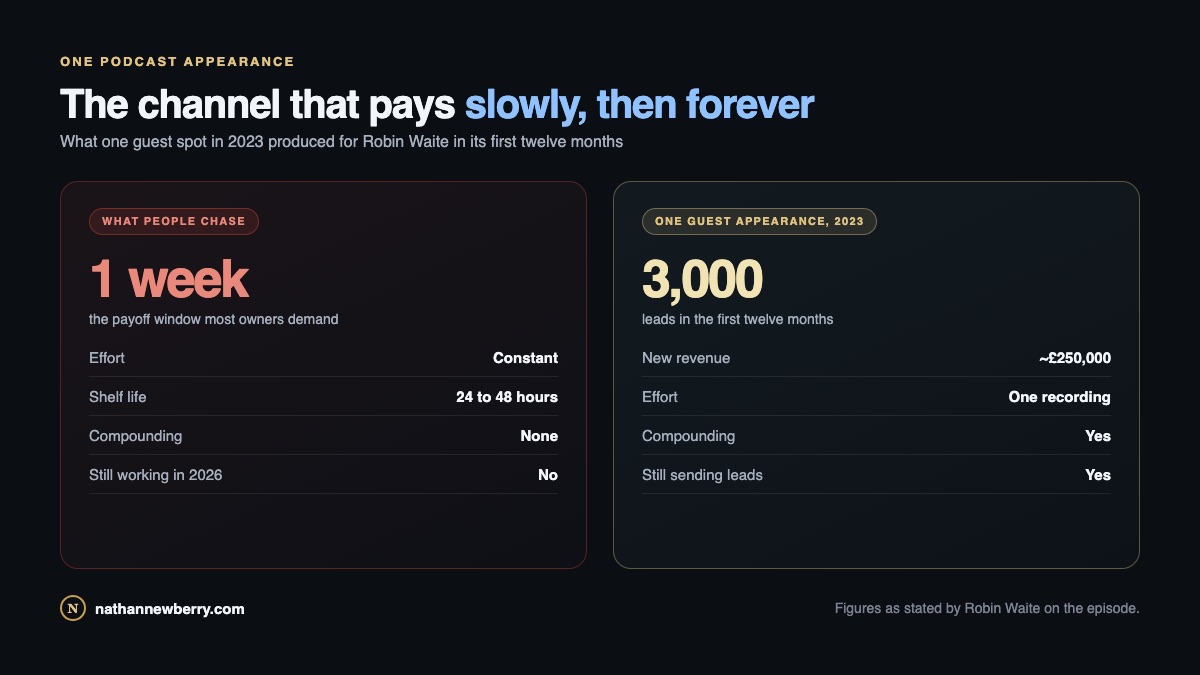
He is careful not to oversell it. You will not get a thousand leads in a week through this. That is exactly why most people skip it in favour of something that looks busier and pays nothing.
And the way those partnerships start is worth copying. He began mentoring a friend's team for free, purely because they were good people to be around. He added value, gave his time, asked for nothing. Eventually one of the team went through a coaching session with him and insisted on paying. Robin turned the money down, because the agreement had been that he was just helping.
That is usually how the useful relationships begin. Be genuinely useful first and let the relationship decide the rest.
WHAT HE ACTUALLY SPENT TO LEARN THIS
I asked him what he has invested in mentorship and education over the years, half expecting him to dodge it.
Two hundred and seventy books in his Audible library. Somewhere north of a hundred thousand dollars in mentors and coaches over about fifteen years.
His biggest regret is the timing. He spent the first five or six years of the agency trying to work everything out alone. He did a business degree, but it was theoretical rather than practical. When he finally hired a mentor, the business doubled year on year for three or four years running.
He is also refreshingly clear that you do not need to spend five figures to start. An Audible credit a month and a solid business book in your ears while you walk the dog is real mentorship. So is the right podcast interview. The gap between someone who compounds and someone who does not is rarely the budget.
THE COST NOBODY CALCULATES
This is the part of the conversation I keep thinking about.
Robin's read on why people say no to help is that human beings cannot think far enough ahead. Look at your own calendar. Next week is packed. Two weeks out is maybe sixty percent full. Three weeks out, forty. Four weeks out there is nothing in it at all, and it feels like there never will be.
So when someone weighs up an investment, they can see the money leaving today and cannot see the second, third and fourth order consequences of not doing it.
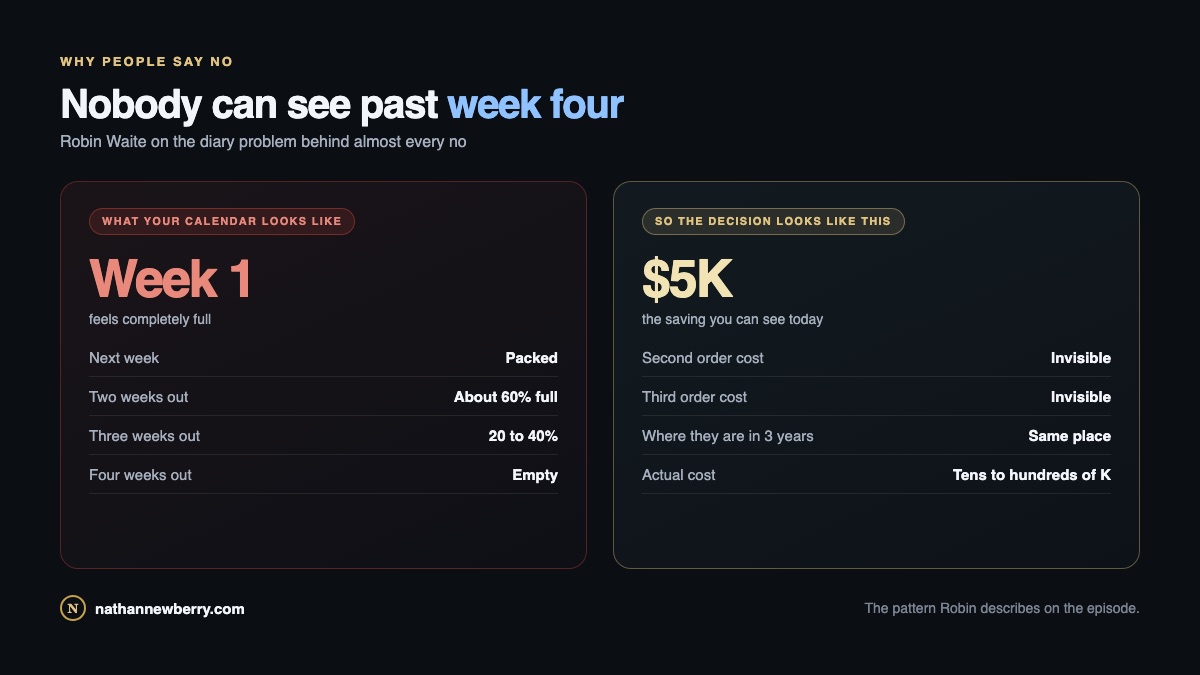
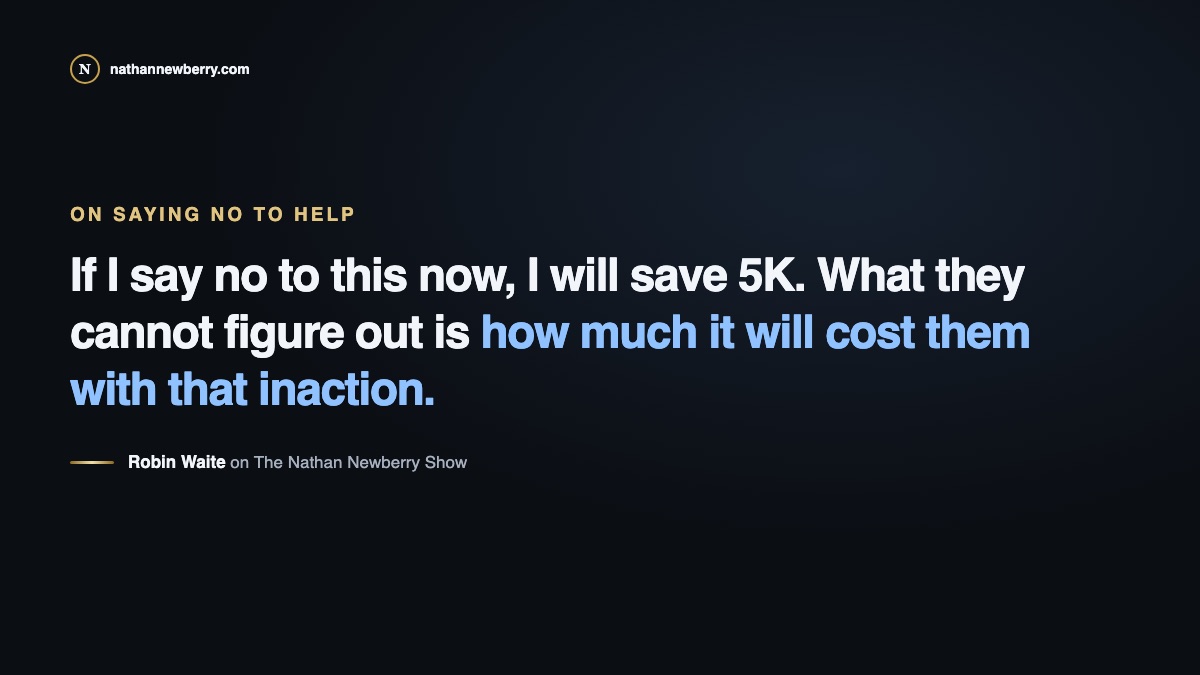
If I say no to this opportunity now, I will save 5K. But what they cannot figure out is how much it is actually going to cost them with that inaction.
He watches clients double and triple revenue in a short stretch. He also watches people say no and then, two or three years later, still be exactly where they were. The cost of that is measured in the tens or hundreds of thousands that never got made, and nobody puts that number on a spreadsheet because it never shows up as a line item.
FEARLESS IS NOT RECKLESS
Given the brand name, I asked how he squares charging ahead with the burnout he now watches for in everyone else.
His answer is that there is a difference between being fearless and being reckless, and that distinction is the whole brand.
The name came from a talk he gave to about a hundred people. Someone asked what makes an entrepreneur successful compared to someone who is not, and he said what helps him is fearing the things that stop him reaching his goals just slightly less than other people do. A friend in the audience stood up mid-talk, pointed at him and called him the fearless business coach. The name stuck.
And the fears he means are ordinary. Raising your prices, for instance. Raise them and you need fewer clients, which gives you more time to deliver something better. Everyone can follow that logic. Almost nobody does it, because the immediate thought is about what might go wrong rather than what usually does.
WHAT TO DO WITH THIS
If you are stuck around a hundred thousand, resist the urge to go and find more leads. The constraint is almost certainly complexity, not demand.
Look at how many different things you sell and how many different types of people you sell them to, and cut. Look at your price, and work out what the business looks like with half the clients at twice the number. Then pick the one relationship-driven channel you have been avoiding because it does not pay off inside a week, and start being useful in it.
That is a slower plan than most advice. It is also the one that does not end with you closing a business you spent twelve years building.
Questions about this episode
Why do coaches stall at 100K?
Because the first 100K can be reached on personal effort. Past that, the constraint is complexity rather than leads. Robin's view is that people are doing too many different things for too many types of people, with too many moving parts, and the fix is to simplify and remove variables before adding anything.
Is it better to raise prices or find more clients?
Robin's position is double the income with half the clients. Fewer clients at a higher price means more time per client, better delivery, and more time away from the business, which is what turns it into a freedom business rather than a job you own.
Do podcast appearances actually generate leads?
They can, but slowly and then durably. Robin guested on one podcast in 2023 which produced roughly 3,000 leads and about 250,000 pounds in new revenue over the following twelve months, and it still sends leads today. It will not produce a thousand leads in a week, which is why most people skip it.
What is the difference between fearless and reckless in business?
Fearless is fearing the things that block your goals slightly less than the next person. Reckless is ignoring the risk. Robin's example of fearless is something as ordinary as raising your prices, which most owners avoid because of what they imagine will happen rather than what usually does.
Build A Business That Funds Your Calling
Two free next steps. Both take one sitting.
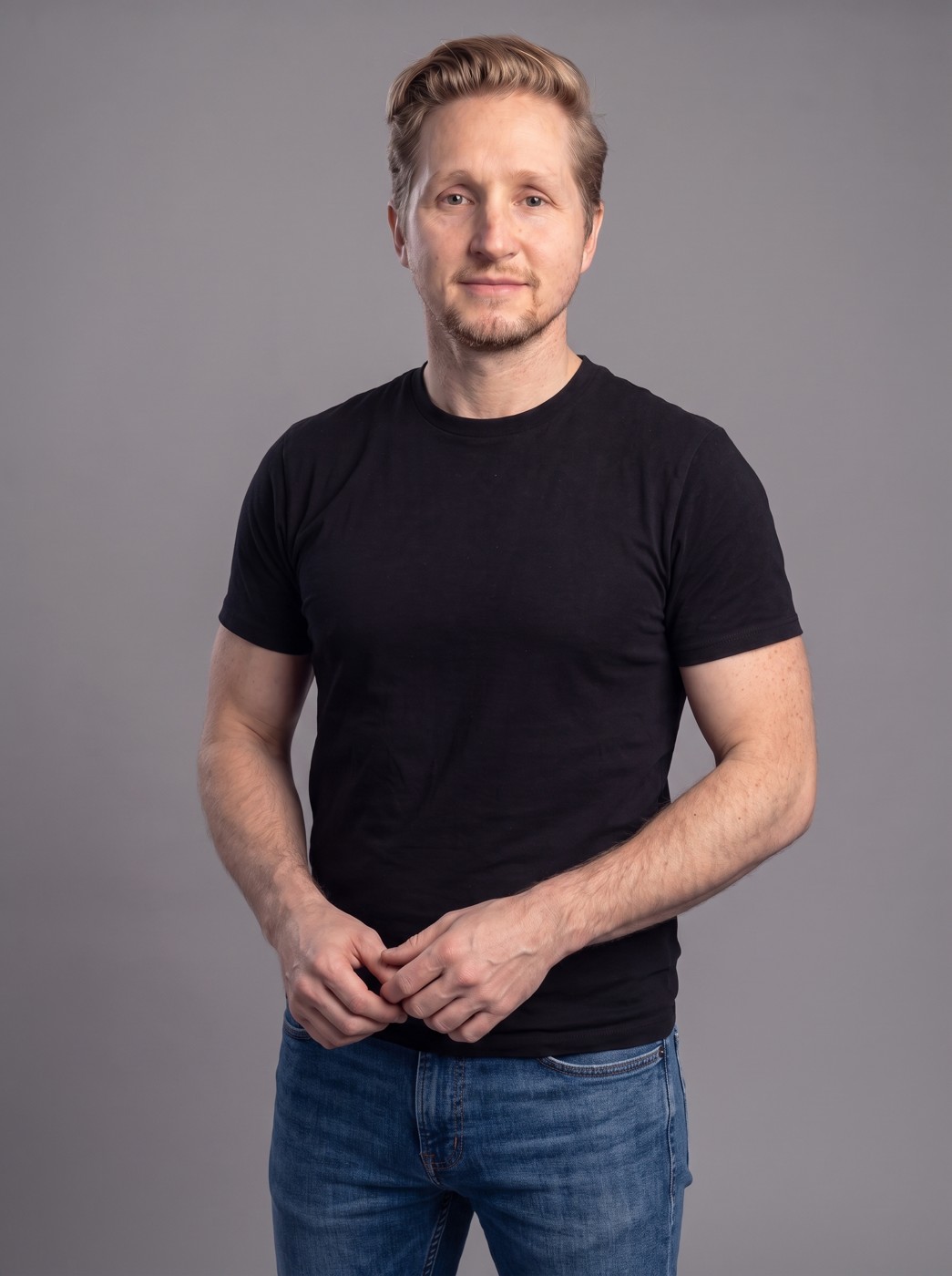
Nathan has led sales teams doing seven figures a month and guided more than 100 owners past six and seven figures. He hosts The Nathan Newberry Show and works with Christian business owners on the offer, the pipeline and the systems that carry the work. More about Nathan